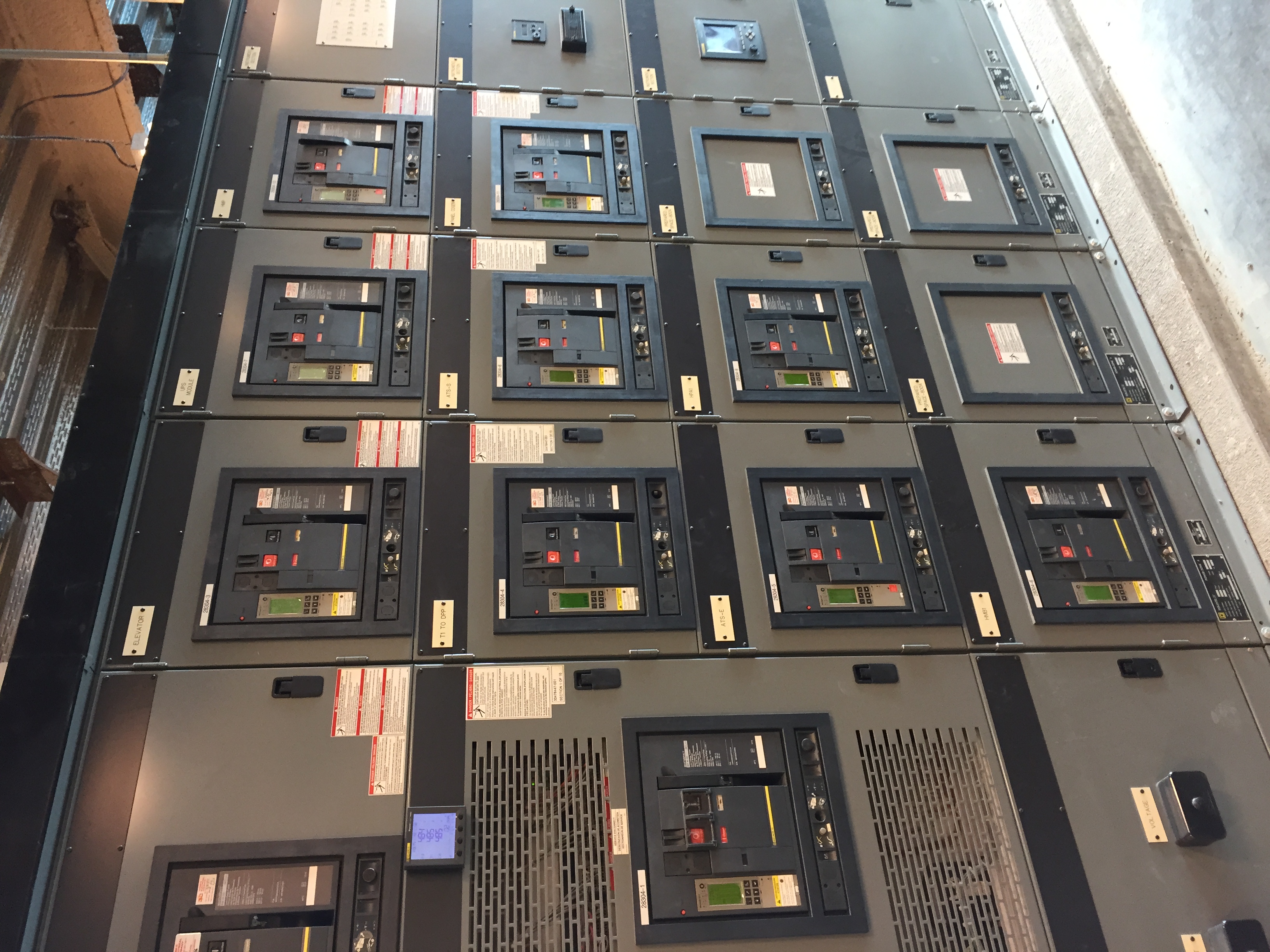
Massachusetts Office-to-Lab Conversion: Electrical, Standby Generator & Low-Voltage Engineering Checklist
A technical due-diligence guide for commercial developers, life-science tenants, and general contractors evaluating existing office buildings in Burlington, Woburn, Billerica, Waltham, and Cambridge for wet-lab or R&D conversion.
1. Service Entrance Capacity: Bridging the 8 W/SF (Office) to 22+ W/SF (Biotech Lab) Gap
A typical Class A commercial office building built along Route 128 or I-93 in the 1980s–2000s was designed for an electrical demand of 6 to 8 Watts per square foot (often served by an 800A or 1,200A service). Converting that same footprint to BSL-2 wet laboratories, vivariums, or additive manufacturing R&D requires 18 to 28+ Watts per square foot due to 100% outside-air make-up air units (MUAs), high-plume lab exhaust fans, chillers, autoclaves, and high-density bench instrumentation.
- Step 1 — 30-Day NEC 220.87 Peak Demand Metering or Load Study: Determine actual spare capacity on existing switchboards before committing to lease timelines.
- Step 2 — Early Switchgear & Transformer Procurement: If a upgrade to 2,000A–4,000A 480Y/277V is required, EDI issues an Early Equipment Release Package during Design Development to beat 30–45 week OEM switchgear lead times.
2. Emergency vs. Legally Required vs. Optional Standby Generator Zoning (NEC 700 / 701 / 702)
Life-science tenants require standby generator protection for two distinct reasons: municipal code compliance (fume hood exhaust and egress) and millions of dollars of biological samples stored in -80°C ultra-low freezers and incubators.
- NEC Article 700 (Life Safety): Egress lighting and fire alarm systems.
- NEC Article 701 (Legally Required Standby): Hazardous laboratory fume hood exhaust fans and make-up air units required to maintain negative room pressurization during a utility outage.
- NEC Article 702 (Optional Equipment Standby): Red-engraved lab bench receptacles, -80°C freezer farms, LN2 monitoring, and server rooms.
Office vs. Biotech R&D Laboratory Electrical Infrastructure Comparison
| Infrastructure Parameter | Standard Commercial Office | BSL-2 Biotech / R&D Wet Lab | EDI Conversion Solution |
|---|---|---|---|
| Primary Power Density | 6 – 8 Watts / Sq. Ft. | 18 – 28+ Watts / Sq. Ft. | 1,200A–4,000A 480Y/277V switchgear & duct bank upgrade |
| Standby Generator Capacity | None (Battery egress lights only) | 300 kW – 1,500 kW+ Diesel/Gas Generator | Multi-ATS architecture (NEC 700, 701 & 702 separation) |
| Branch Circuit Density | 1 circuit per 4–6 workstations | Dedicated 20A/30A 120V/208V per bench bay + IG | Overhead Starline busway or stainless lab bench raceways |
| Low Voltage & Security | Standard Cat6 & perimeter card access | Cat6A/OM4 fiber + cleanroom mantrap interlocks | Single-source EDI Network Systems + FACP relay integration |
Request an On-Site Engineering Evaluation or Compliance Proposal
Direct routing to Electrical Dynamics Estimating (info@electricaldynamics.com), 24/7 Service & Fire Alarm (service@electricaldynamics.com), or EDI Network Systems (telecom@electricaldynamics.com).